The 16-day government shutdown cost the economy jobs, delayed mortgages and lost retail sales — at least $12 billion worth, and maybe as much as $24 billion.
As federal workers returned to work Thursday, statisticians and business people began toting up the damage:
• Estimates of the toll range from $12 billion to $24 billion for the U.S. economy, or as much as $1.5 billion per day, and as many as 250,000 jobs. The shutdown trimmed fourth-quarter growth by 20%, economist Joel Naroff said — an outcome any business would "consider a disaster.''
• At least 400,000 government employees will be paid for all 16 days they didn't work and roughly the same number will get paid for not working during part of the shutdown. The government has not disclosed that cost
MORE: In fiscal fight, Obama looks to next battle
• Consumer confidence plunged. The Bloomberg Consumer Comfort Index fell to its lowest level since March in data released Thursday. The share of people predicting economic conditions will get worse fell faster than at any time since the 2008 collapse of investment bank Lehman Bros. One result: Hyundai's CEO John Krafcik said this week that October car sales could drop about 10%.
• The U.S. Travel Association said the shutdown cost $152 million a day in lost travel and related activity. Federal parks were closed, accounting for much of the losses. Washington-area hotel occupancy dropped 9% from late September levels in the first week of October, according to Destination D.C.
In Colorado Springs, home of the Air Force Academy, all six group events scheduled at Edelweiss Restaurant the past couple of weeks were canceled, reducing the eatery's revenue by about 10%, says owner Deiter Schnakenberg.
• The Mortgage Bankers Association of America said applications for mortgages dropped 7% last week, to the lowest levels seen since 2007. "The government shutdown had a notable impact on the mortgage market last week," the association said.
![]()
The sun begins to rise behind the Capitol building on Oct. 17 in Washington. A bipartisan bill was passed by the House and Senate to end the partial government shutdown and raise the nation's debt limit. Mark Wilson, Getty ImagesFullscreen
![U.S. Park Service workers remove road closure cones as government workers return to their jobs in Washington. President Obama signed a bill that will fund the government until Jan. 15 and allow the government to pay bills until Feb. 7.]()
U.S. Park Service workers remove road closure cones as government workers return to their jobs in Washington. President Obama signed a bill that will fund the government until Jan. 15 and allow the government to pay bills until Feb. 7. Mark Wilson, Getty ImagesFullscreen
![Rep. G.K. Butterfield, D-N.C., left, leaves the House after a bipartisan bill to end the partial government shutdown and raise the nation's debt limit passed the House and the Senate on Oct. 16 at the Capitol in Washington.]()
Rep. G.K. Butterfield, D-N.C., left, leaves the House after a bipartisan bill to end the partial government shutdown and raise the nation's debt limit passed the House and the Senate on Oct. 16 at the Capitol in Washington. Andrew Burton, Getty ImagesFullscreen
![President Obama delivers a statement to reporters at the Brady Press Briefing Room at the White House after lawmakers reached a bipartisan deal to avoid default and reopen the government.]()
President Obama delivers a statement to reporters at the Brady Press Briefing Room at the White House after lawmakers reached a bipartisan deal to avoid default and reopen the government. Charles Dharapak, APFullscreen
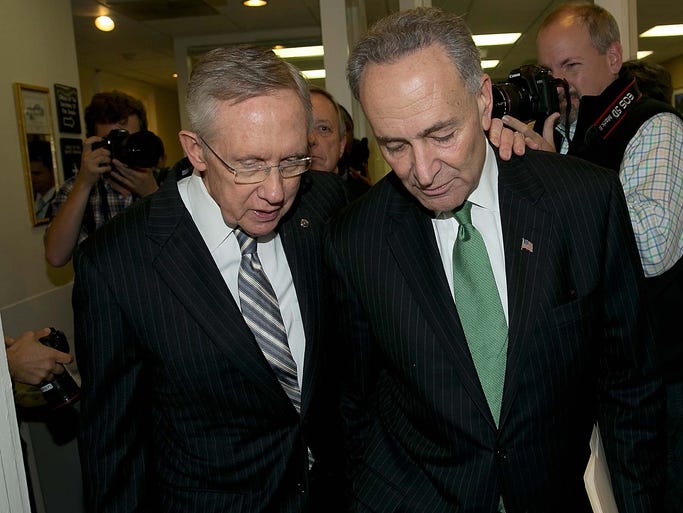
![Senate Majority Leader Harry Reid, D-Nev., left, embraces Sen. Charles Schumer, D-N.Y., after the Senate voted to fund the federal government and raise the debt limit.]()
Senate Majority Leader Harry Reid, D-Nev., left, embraces Sen. Charles Schumer, D-N.Y., after the Senate voted to fund the federal government and raise the debt limit. Win McNamee, Getty ImagesFullscreen
![A television image shows the final vote total in the House of Representatives.]()
A television image shows the final vote total in the House of Representatives. House TV via APFullscreen
![Speaker of the House John Boehner, R-Ohio, center, walks through Statuary Hall with his entourage as he prepares to vote in the House of Representatives to end the government shutdown and raise the debt limit at the Capitol.]()
Speaker of the House John Boehner, R-Ohio, center, walks through Statuary Hall with his entourage as he prepares to vote in the House of Representatives to end the government shutdown and raise the debt limit at the Capitol. Win McNamee, Getty ImagesFullscreen
![Senate Minority Leader Mitch McConnell, R-Ky., heads to the Senate floor on Capitol Hill.]()
Senate Minority Leader Mitch McConnell, R-Ky., heads to the Senate floor on Capitol Hill. Jewel Samad, AFP/Getty ImagesFullscreen
![Sen. Chuck Schumer, D-N.Y., discusses the bipartisan bill at a news conference on Capitol Hill. With Schumer are Senate Majority Leader Harry Reid, D-Nev., left, Sen. Patty Murray, D-Wash., and Sen. Dick Durbin, D-Ill.]()
Sen. Chuck Schumer, D-N.Y., discusses the bipartisan bill at a news conference on Capitol Hill. With Schumer are Senate Majority Leader Harry Reid, D-Nev., left, Sen. Patty Murray, D-Wash., and Sen. Dick Durbin, D-Ill. Evan Vucci, APFullscreen
![Rep. Louie Gohmert, R-Texas., listens during a joint hearing with the House Natural Resources Committee and the House Oversight and Government Reform Committee on Capitol Hill.]()
Rep. Louie Gohmert, R-Texas., listens during a joint hearing with the House Natural Resources Committee and the House Oversight and Government Reform Committee on Capitol Hill. Susan Walsh, APFullscreen
![House Minority Leader Rep. Nancy Pelosi, D-Calif., left, talks with House Budget Committee ranking member Rep. Chris Van Hollen, D-Md., as a congressional staff member waits by the door after a House Democratic leadership meeting on Capitol Hill.]()
House Minority Leader Rep. Nancy Pelosi, D-Calif., left, talks with House Budget Committee ranking member Rep. Chris Van Hollen, D-Md., as a congressional staff member waits by the door after a House Democratic leadership meeting on Capitol Hill. Alex Wong, Getty ImagesFullscreen
![Sen. Ted Cruz, R-Texas, speaks to the media after Senate Republicans reached a last-minute agreement to avert a financial default and end the partial government shutdown.]()
Sen. Ted Cruz, R-Texas, speaks to the media after Senate Republicans reached a last-minute agreement to avert a financial default and end the partial government shutdown. H. Darr Beiser, USA TODAYFullscreen
![Journalists question Sen. Lidsay Graham, R-S.C., at the Capitol.]()
Journalists question Sen. Lidsay Graham, R-S.C., at the Capitol. H. Darr Beiser, USA TODAYFullscreen
![Furloughed federal employees protest against the partial government shutdown outside the Capitol on Oct. 16.]()
Furloughed federal employees protest against the partial government shutdown outside the Capitol on Oct. 16. H. Darr Beiser, USA TODAYFullscreen
![Sen. John McCain, R-Ariz., center, is mobbed by reporters.]()
Sen. John McCain, R-Ariz., center, is mobbed by reporters. H. Darr Beiser, USA TODAYFullscreen
![Reverend Jim Wallis, center, leads a prayer in front of the Capitol.]()
Reverend Jim Wallis, center, leads a prayer in front of the Capitol. Andrew Burton, Getty ImagesFullscreen
![Sen. Susan Collins, R-Maine, and Sen. John McCain, R-Ariz., arrive at Senate Minority Leader Mitch McConnell's office for a meeting on Oct 16.]()
Sen. Susan Collins, R-Maine, and Sen. John McCain, R-Ariz., arrive at Senate Minority Leader Mitch McConnell's office for a meeting on Oct 16. Andrew Burton, Getty ImagesFullscreen
![Senate Majority Leader Sen. Harry Reid, D-Nev., walks to his office on Capitol Hill.]()
Senate Majority Leader Sen. Harry Reid, D-Nev., walks to his office on Capitol Hill. Evan Vucci, APFullscreen
![Speaker of the House John Boehner, R-Ohio, left, arrives at the Capitol on Oct 16.]()
Speaker of the House John Boehner, R-Ohio, left, arrives at the Capitol on Oct 16. Karen Bleier, AFP/Getty ImagesFullscreen
![House Rules Committee member Rep. Virginia Foxx, R-N.C., makes a phone call outside the committee room after the panel postponed its work on a House bill that would reopen the government and avert a financial default on Oct. 15.]()
House Rules Committee member Rep. Virginia Foxx, R-N.C., makes a phone call outside the committee room after the panel postponed its work on a House bill that would reopen the government and avert a financial default on Oct. 15. J. Scott Applewhite, APFullscreen
![A congressional staffer delivers pizzas at the Capitol as the Senate and House work on a deal to end the partial government shutdown and raise the debt ceiling.]()
A congressional staffer delivers pizzas at the Capitol as the Senate and House work on a deal to end the partial government shutdown and raise the debt ceiling. Alex Wong, Getty ImagesFullscreen
![Sen. Mary Landrieu, D-La., left, talks with Sen. Patrick Leahy, D-Vt., before the start of a Senate Democratic Policy luncheon at the Capitol.]()
Sen. Mary Landrieu, D-La., left, talks with Sen. Patrick Leahy, D-Vt., before the start of a Senate Democratic Policy luncheon at the Capitol. Alex Wong, Getty ImagesFullscreen
![House Majority Leader Eric Cantor, R-Va., is followed by reporters as he leaves Capitol Hill.]()
House Majority Leader Eric Cantor, R-Va., is followed by reporters as he leaves Capitol Hill. Carolyn Kaster, APFullscreen
![President Obama, center, and Vice President Joe Biden, center left, meet with the Democratic leadership in the Oval Office of the White House.]()
President Obama, center, and Vice President Joe Biden, center left, meet with the Democratic leadership in the Oval Office of the White House. Pablo Martinez Monsivais, APFullscreen
![Sen. Susan Collins , R-Maine, talks with reporters after a weekly policy luncheon on Capitol Hill.]()
Sen. Susan Collins , R-Maine, talks with reporters after a weekly policy luncheon on Capitol Hill. Jim Watson, AFP/Getty ImagesFullscreen
![Omayra Hernadez protests against the partial government shutdown at the offices of Rep. Mario Diaz-Balart, R-Fla., and Sen. Marco Rubio, R-Fla., in Doral, Fla.]()
Omayra Hernadez protests against the partial government shutdown at the offices of Rep. Mario Diaz-Balart, R-Fla., and Sen. Marco Rubio, R-Fla., in Doral, Fla. Joe Raedle, Getty ImagesFullscreen
![Speaker of the House Rep. John Boehner, R-Ohio, center, answers questions from the press after a meeting of House Republicans at the Capitol in Washington.]()
Speaker of the House Rep. John Boehner, R-Ohio, center, answers questions from the press after a meeting of House Republicans at the Capitol in Washington. Win McNamee, Getty ImagesFullscreen
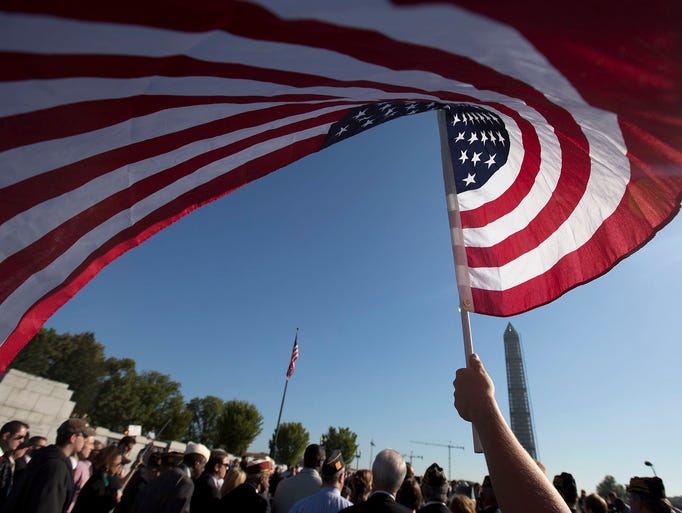
![Terri Shreiner waves an American flag during a rally against the partial government shutdown at the National World War II Memorial in Washington.]()
Terri Shreiner waves an American flag during a rally against the partial government shutdown at the National World War II Memorial in Washington. Carolyn Kaster, APFullscreen
![Senate Majority Leader Sen. Harry Reid, D-Nev., center, is surrounded by reporters after leaving the office of Senate Minority Leader Sen. Mitch McConnell, R-Ky., on Oct. 14 on Capitol Hill. Reid and McConnell are attempting to hammer out a deal to end the partial government shutdown and raise the debt ceiling.]()
Senate Majority Leader Sen. Harry Reid, D-Nev., center, is surrounded by reporters after leaving the office of Senate Minority Leader Sen. Mitch McConnell, R-Ky., on Oct. 14 on Capitol Hill. Reid and McConnell are attempting to hammer out a deal to end the partial government shutdown and raise the debt ceiling. Evan Vucci, APFullscreen
![Sen. Chuck Schumer, D-N.Y., left, speaks with Sen. John Barrasso, R-Wyo., in an elevator on Oct. 13 in Washington.]()
Sen. Chuck Schumer, D-N.Y., left, speaks with Sen. John Barrasso, R-Wyo., in an elevator on Oct. 13 in Washington. Andrew Burton, Getty ImagesFullscreen
![Tourists pose for pictures during a visit to the Statue of Liberty in New York City. The Statue of Liberty reopened to the public after the state of New York agreed to shoulder the costs of running the site during the federal government shutdown.]()
Tourists pose for pictures during a visit to the Statue of Liberty in New York City. The Statue of Liberty reopened to the public after the state of New York agreed to shoulder the costs of running the site during the federal government shutdown. Kena Betancur, Getty ImagesFullscreen
![A protester demonstrates in front of the White House.]()
A protester demonstrates in front of the White House. Jewel Samad, AFP/Getty ImagesFullscreen
![Protesters remove barricades around the National World War II Memorial during a demonstration demanding an end to the government shutdown.]()
Protesters remove barricades around the National World War II Memorial during a demonstration demanding an end to the government shutdown. Jewel Samad, AFP/Getty ImagesFullscreen
![Protesters demonstrate against the government shutdown at the National World War II Memorial.]()
Protesters demonstrate against the government shutdown at the National World War II Memorial. Jewel Samad, AFP/Getty ImagesFullscreen
![A protester dressed as comic book superhero Captain America joins veterans during a demonstration at the World War II memorial.]()
A protester dressed as comic book superhero Captain America joins veterans during a demonstration at the World War II memorial. Jewel Samad, AFP/Getty ImagesFullscreen
![Protesters demonstrate at the World War II memorial.]()
Protesters demonstrate at the World War II memorial. Jewel Samad, AFP/Getty ImagesFullscreen
![Park ranger Patti Vanscyoc gives directions to park visitors at the entrance to the now-open Zion National Park on Oct. 12 in Springdale, Utah.]()
Park ranger Patti Vanscyoc gives directions to park visitors at the entrance to the now-open Zion National Park on Oct. 12 in Springdale, Utah. David Becker, Getty ImagesFullscreen
![Kayvan Khiabani photographs the scenery above the north fork of the Virgin River in Zion National Park.]()
Kayvan Khiabani photographs the scenery above the north fork of the Virgin River in Zion National Park. David Becker, Getty ImagesFullscreen
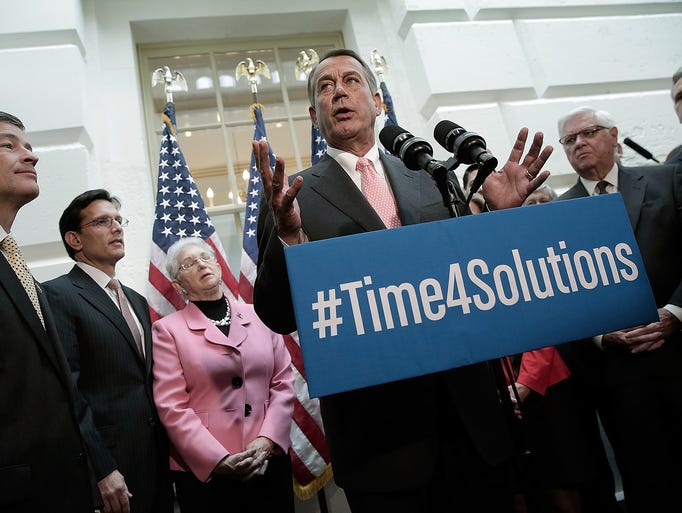
![Speaker of the House John Boehner, R-Ohio, speaks during a press conference Oct. 10 at the Capitol in Washington. Boehner announced he is prepared to have the House vote on a short-term increase in the debt limit.]()
Speaker of the House John Boehner, R-Ohio, speaks during a press conference Oct. 10 at the Capitol in Washington. Boehner announced he is prepared to have the House vote on a short-term increase in the debt limit. Win McNamee, Getty ImagesFullscreen
![House Minority Leader Nancy Pelosi, D-Calif., speaks during a rally to urge Congress to end the partial government shutdown outside the U.S. Capitol. The shutdown is in its 10th day.]()
House Minority Leader Nancy Pelosi, D-Calif., speaks during a rally to urge Congress to end the partial government shutdown outside the U.S. Capitol. The shutdown is in its 10th day. Mark Wilson, Getty ImagesFullscreen
![Treasury Secretary Jacob Lew is surrounded by photographers before testifying about the government debt ceiling before the Senate Finance Committee on Capitol Hill. Lew told the committee that failure to renew the government's ability to borrow money could damage financial markets and threaten jobs and savings.]()
Treasury Secretary Jacob Lew is surrounded by photographers before testifying about the government debt ceiling before the Senate Finance Committee on Capitol Hill. Lew told the committee that failure to renew the government's ability to borrow money could damage financial markets and threaten jobs and savings. Evan Vucci, APFullscreen
![Chris Cox of Mount Pleasant, S.C., pushes a cart loaded with a lawn mower and other gardening tools near the Lincoln Memorial on Oct. 9 in Washington. Cox is mowing and cleaning up the grounds around the Lincoln Memorial during the government shutdown.]()
Chris Cox of Mount Pleasant, S.C., pushes a cart loaded with a lawn mower and other gardening tools near the Lincoln Memorial on Oct. 9 in Washington. Cox is mowing and cleaning up the grounds around the Lincoln Memorial during the government shutdown. Manuel Balce Ceneta, APFullscreen
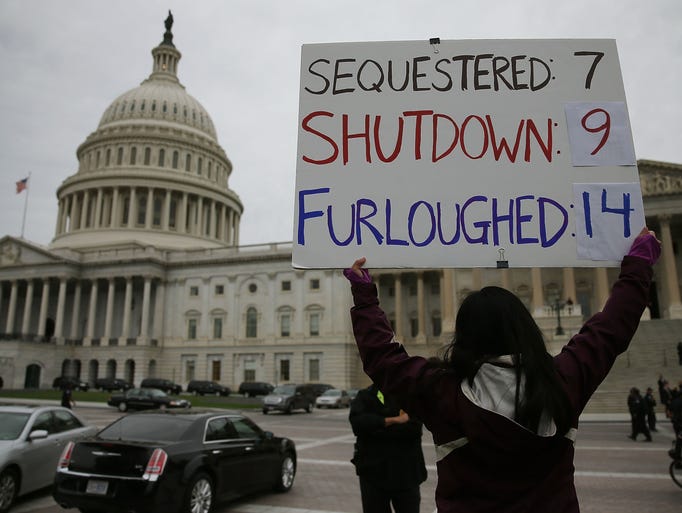
![A woman protests against the partial government shutdown outside the Capitol.]()
A woman protests against the partial government shutdown outside the Capitol. Mark Wilson, Getty ImagesFullscreen
![Senate Majority Leader Harry Reid, D-Nev., left, speaks with his communications director, Adam Jentleson, on the steps of the Capitol.]()
Senate Majority Leader Harry Reid, D-Nev., left, speaks with his communications director, Adam Jentleson, on the steps of the Capitol. Win McNamee, Getty ImagesFullscreen
![Majority Leader Eric Cantor, R-Va., second from left, walks through Statuary Hall at the Capitol.]()
Majority Leader Eric Cantor, R-Va., second from left, walks through Statuary Hall at the Capitol. Mark Wilson, Getty ImagesFullscreen
![Protesters demonstrate in Washington.]()
Protesters demonstrate in Washington. Win McNamee, Getty ImagesFullscreen
![Anglers stage a protest against the closure of Everglades National Park in Islamorada, Fla. About a third of the 2,380-square-mile park encompasses Florida Bay and is closed to Florida Keys guides and recreational fishermen.]()
Anglers stage a protest against the closure of Everglades National Park in Islamorada, Fla. About a third of the 2,380-square-mile park encompasses Florida Bay and is closed to Florida Keys guides and recreational fishermen. Andy Newman, Florida Keys News Bureau, via APFullscreen
![Protesters demonstrate againist government shutdown on Capitol Hill on Oct. 4 in Washington.]()
Protesters demonstrate againist government shutdown on Capitol Hill on Oct. 4 in Washington. Evan Vucci, APFullscreen
![Federal workers demonstrate against the government shutdown in front of the Capitol in Washington.]()
Federal workers demonstrate against the government shutdown in front of the Capitol in Washington. Nicholas Kamm, AFP/Getty ImagesFullscreen
![Grand Canyon National Park Ranger Jason Morris talks to people on a motorcycle at the closed park entrance on Oct. 3 in Arizona. National parks are closed as Congress remains deadlocked over federal government funding.]()
Grand Canyon National Park Ranger Jason Morris talks to people on a motorcycle at the closed park entrance on Oct. 3 in Arizona. National parks are closed as Congress remains deadlocked over federal government funding. Brian Skoloff, APFullscreen
![Demonstrators protest against the government shutdown outside the office of Rep. Todd Rokita, R-Ind., outside his office in Lafayette, Ind.]()
Demonstrators protest against the government shutdown outside the office of Rep. Todd Rokita, R-Ind., outside his office in Lafayette, Ind. Brent Drinkut, The Journal & Courier, via APFullscreen
![Greg Frus, a contract aircraft mechanic with L-3 Vertex, works in a closed National Guard aircraft maintenance facility at Joint Base Lewis-McChord in Washington. Frus is a contractor and is not currently affected by the shutdown.]()
Greg Frus, a contract aircraft mechanic with L-3 Vertex, works in a closed National Guard aircraft maintenance facility at Joint Base Lewis-McChord in Washington. Frus is a contractor and is not currently affected by the shutdown. Ted S. Warren, APFullscreen
![Rep. Tom Cole, R-Okla., walks to the chamber as Congress continues to struggle with the government shutdown, at the Capitol in Washington.]()
Rep. Tom Cole, R-Okla., walks to the chamber as Congress continues to struggle with the government shutdown, at the Capitol in Washington. J. Scott Applewhite, APFullscreen
![Protesters demonstrate against the partial government shutdown in front of the Capitol in Washington.]()
Protesters demonstrate against the partial government shutdown in front of the Capitol in Washington. Jewel Samad, AFP/Getty ImagesFullscreen
![Sen. Mary Landrieu, D-La., center, speaks to reporters about the impact of the government shutdown on small business owners on Capitol Hill.]()
Sen. Mary Landrieu, D-La., center, speaks to reporters about the impact of the government shutdown on small business owners on Capitol Hill. Evan Vucci, APFullscreen
![A sign informs visitors the National Mall is closed.]()
A sign informs visitors the National Mall is closed. Jewel Samad, AFP/Getty ImagesFullscreen
![World War II veteran Tom Lyle, seated, is escorted by a member of Honor Flights through the World War II Memorial in Washington. Veterans are being allowed past barricades at the memorial.]()
World War II veteran Tom Lyle, seated, is escorted by a member of Honor Flights through the World War II Memorial in Washington. Veterans are being allowed past barricades at the memorial. Jim Watson, AFP/Getty ImagesFullscreen
![Sen. John Boozman, R-Ark., leads a tour in the Rotunda on Capitol Hill in Washington. Congressional staffers and interns usually lead constituent tours, but due to the government shutdown, members of Congress have begun to lead tour groups from their home states.]()
Sen. John Boozman, R-Ark., leads a tour in the Rotunda on Capitol Hill in Washington. Congressional staffers and interns usually lead constituent tours, but due to the government shutdown, members of Congress have begun to lead tour groups from their home states. Evan Vucci, APFullscreen
![Rep. Mike McIntyre, D-N.C., center, speaks with students from North Carolina and exchange students from Denmark on Capitol Hill in Washington. The students were not able to tour the Capitol building because of the partial government shutdown.]()
Rep. Mike McIntyre, D-N.C., center, speaks with students from North Carolina and exchange students from Denmark on Capitol Hill in Washington. The students were not able to tour the Capitol building because of the partial government shutdown. Brendan Smialowski, AFP/Getty ImagesFullscreen
![People walk past a barricade preventing them from entering the World War II Memorial during a partial government shutdown in Washington.]()
People walk past a barricade preventing them from entering the World War II Memorial during a partial government shutdown in Washington. Susan Walsh, APFullscreen
![Speaker of the House John Boehner, R-Ohio, speaks after a meeting with President Obama at the White House.]()
Speaker of the House John Boehner, R-Ohio, speaks after a meeting with President Obama at the White House. Win McNamee, Getty ImagesFullscreen
![House Minority Leader Nancy Pelosi, D-Calif., left, and Senate Majority Leader Harry Reid, D-Nev., speak to the media with after a meeting with President Obama at the White House.]()
House Minority Leader Nancy Pelosi, D-Calif., left, and Senate Majority Leader Harry Reid, D-Nev., speak to the media with after a meeting with President Obama at the White House. Win McNamee, Getty ImagesFullscreen
![Furloughed federal workers chant slogans and shout as House Majority Leader Eric Cantor, R-Va., and fellow House Republicans hold a news conference on the West Front of the Capitol.]()
Furloughed federal workers chant slogans and shout as House Majority Leader Eric Cantor, R-Va., and fellow House Republicans hold a news conference on the West Front of the Capitol. Chip Somodevilla, Getty ImagesFullscreen
![A protester demonstrates on Capitol Hill.]()
A protester demonstrates on Capitol Hill. Brendan Smialowski, AFP/Getty ImagesFullscreen
![A man peers through the locked front doors of the Richard Nixon Presidential Library and Museum in Yorba Linda, Calif.]()
A man peers through the locked front doors of the Richard Nixon Presidential Library and Museum in Yorba Linda, Calif. David McNew, Getty ImagesFullscreen
![Vicki Maturo chants slogans during a protest against the government shutdown outside the federal building in Los Angeles.]()
Vicki Maturo chants slogans during a protest against the government shutdown outside the federal building in Los Angeles. Jae C. Hong, APFullscreen
![Joe Lee, left,and Lance Frye protest against the partial government shutdown outside the World War II Memorial in Washington.]()
Joe Lee, left,and Lance Frye protest against the partial government shutdown outside the World War II Memorial in Washington. Alex Wong, Getty ImagesFullscreen
![A child stands on the barricade around the Lincoln Memorial in Washington.]()
A child stands on the barricade around the Lincoln Memorial in Washington. Jewel Samad, AFP/Getty ImagesFullscreen
![Jorge Alvarez, a National Park Service employee, hangs a sign in front of the Vietnam Veterans Memorial the second day of a partial government shutdown in Washington, D.C.]()
Jorge Alvarez, a National Park Service employee, hangs a sign in front of the Vietnam Veterans Memorial the second day of a partial government shutdown in Washington, D.C. Jim Lo Scalzo, epaFullscreen
![Barricades close a street in front of the Smithsonian National Museum of the American Indian in Washington.]()
Barricades close a street in front of the Smithsonian National Museum of the American Indian in Washington. Carolyn Kaster, APFullscreen
![A furloughed government union worker demonstrates on Constitution Avenue in Washington.]()
A furloughed government union worker demonstrates on Constitution Avenue in Washington. Win McNamee, Getty ImagesFullscreen
![Sebastian Ramirez hikes out of the Bright Angel Trail on Oct. 1 in Grand Canyon National Park in Arizona.]()
Sebastian Ramirez hikes out of the Bright Angel Trail on Oct. 1 in Grand Canyon National Park in Arizona. Tom Tingle, The Arizona Republic, via APFullscreen
![A sign tells employees where to pick up their furlough letters at Mt. Rainier National Park administration building near Ashford, Wash.]()
A sign tells employees where to pick up their furlough letters at Mt. Rainier National Park administration building near Ashford, Wash. Pete Caster, The Chronicle, via APFullscreen
![TOPSHOTS A protester covers his mouth with a dollar bill as he joins others in a demonstration in front of the US Capitol in Washington, DC, on October 1, 2013 urging congress to pass the budget bill. US President Obama slammed Republicans for shutting down the government as part of an "ideological crusade" designed to kill his signature health care law. The US government shut down on October 1, 2013 for the first time in 17 years after a gridlocked Congress failed to reach a federal budget deal amid bitter brinkmanship. Some 800,000 federal workers have been furloughed in a move reminiscent of two previous shutdowns -- for six days in November 1995 and 21 days from December that year into early 1996. AFP Photo / Jewel SamadJEWEL SAMAD/AFP/Getty Images ORG XMIT: 182975099 ORIG FILE ID: 523439997]()
TOPSHOTS A protester covers his mouth with a dollar bill as he joins others in a demonstration in front of the US Capitol in Washington, DC, on October 1, 2013 urging congress to pass the budget bill. US President Obama slammed Republicans for shutting down the government as part of an "ideological crusade" designed to kill his signature health care law. The US government shut down on October 1, 2013 for the first time in 17 years after a gridlocked Congress failed to reach a federal budget deal amid bitter brinkmanship. Some 800,000 federal workers have been furloughed in a move reminiscent of two previous shutdowns -- for six days in November 1995 and 21 days from December that year into early 1996. AFP Photo / Jewel SamadJEWEL SAMAD/AFP/Getty Images ORG XMIT: 182975099 ORIG FILE ID: 523439997 JEWEL SAMAD AFP/Getty ImagesFullscreen
![Signs inform people that the Statue of Liberty is closed due to a partial government shutdown on Oct. 1 in Battery Park, N.Y.]()
Signs inform people that the Statue of Liberty is closed due to a partial government shutdown on Oct. 1 in Battery Park, N.Y. Robert Deutsch, USA TODAYFullscreen
![A vendor has no customers after the Statue of Liberty was closed in New York.]()
A vendor has no customers after the Statue of Liberty was closed in New York. Robert Deutsch, USA TODAYFullscreen
![Independence Mall in Philadelphia was closed due to the government shutdown.]()
Independence Mall in Philadelphia was closed due to the government shutdown. Eileen Blass, USA TODAYFullscreen
![Park Rangers erect barricades around Independence Hall at Independence National Historical Park in Philadelphia.]()
Park Rangers erect barricades around Independence Hall at Independence National Historical Park in Philadelphia. Matt Rourke, APFullscreen
![Furloughed federal employees demonstrate at Independence National Historical Park.]()
Furloughed federal employees demonstrate at Independence National Historical Park. Matt Rourke, APFullscreen
![A sign informs visitors to Faneuil Hall, the nation's oldest public meeting hall, that restrooms are closed as a result of the partial government shutdown in Boston.]()
A sign informs visitors to Faneuil Hall, the nation's oldest public meeting hall, that restrooms are closed as a result of the partial government shutdown in Boston. Stephan Savoia, APFullscreen
![Visitors take photographs outside the closed San Francisco Maritime National Historical Park.]()
Visitors take photographs outside the closed San Francisco Maritime National Historical Park. Justin Sullivan, Getty ImagesFullscreen
![National Park Service worker Michael Faw posts a sign at Crissy Field in San Francisco.]()
National Park Service worker Michael Faw posts a sign at Crissy Field in San Francisco. Justin Sullivan, Getty ImagesFullscreen
![Hot Springs National Park employee Stacy Jackson prepares to set up a barricade to close Arlington Lawn at Hot Springs National Park in Arkansas.]()
Hot Springs National Park employee Stacy Jackson prepares to set up a barricade to close Arlington Lawn at Hot Springs National Park in Arkansas. Richard Rasmussen, The Sentinel-Record, via APFullscreen
![Jeanne Holler, deputy refuge manager at the Minnesota Valley Wildlife Center, closes the facility in Bloomington, Minn.]()
Jeanne Holler, deputy refuge manager at the Minnesota Valley Wildlife Center, closes the facility in Bloomington, Minn. Elizabeth Flores, Star Tribune, via APFullscreen
![House Majority Leader Eric Cantor, R-Va., second from left, takes a question from a member of the news media on Capitol Hill in Washington, D.C.]()
House Majority Leader Eric Cantor, R-Va., second from left, takes a question from a member of the news media on Capitol Hill in Washington, D.C. Michael Reynolds, epaFullscreen
![President Obama delivers remarks about the launch of the Affordable Care Act and the partial government shutdown in the Rose Garden of the White House.]()
President Obama delivers remarks about the launch of the Affordable Care Act and the partial government shutdown in the Rose Garden of the White House. Chip Somodevilla, Getty ImagesFullscreen
![Lake Mead National Recreation Area park maintenance worker Donna Curry locks up a restroom facility near Boulder City, Nev.]()
Lake Mead National Recreation Area park maintenance worker Donna Curry locks up a restroom facility near Boulder City, Nev. Julie Jacobson, APFullscreen
![World War II Veteran George Bloss looks out over the National World War II Memorial in Washington. Veterans who traveled to Washington from across the country were allowed to visit the World War II memorial after it had been officially closed because of the partial government shutdown.]()
World War II Veteran George Bloss looks out over the National World War II Memorial in Washington. Veterans who traveled to Washington from across the country were allowed to visit the World War II memorial after it had been officially closed because of the partial government shutdown. Carolyn Kaster, APFullscreen
![Members of the Mississippi Gulf Coast Honor Flight to tour the World War II Memorial in Washington.]()
Members of the Mississippi Gulf Coast Honor Flight to tour the World War II Memorial in Washington. Jared Soares for USA TODAYFullscreen
![A National Park Service ranger puts up a sign indicating all facilities at the Martin Luther King Historic Site in Atlanta.]()
A National Park Service ranger puts up a sign indicating all facilities at the Martin Luther King Historic Site in Atlanta. Erik S. Lesser, epaFullscreen
![National Zoological Park police officer Will Jones informs visitor Miguel Miranda and his family that the Smithsonian zoo is closed in Washington, D.C.]()
National Zoological Park police officer Will Jones informs visitor Miguel Miranda and his family that the Smithsonian zoo is closed in Washington, D.C. Manuel Balce Ceneta, APFullscreen
![Fay Wagstaff, a visitor from El Paso, Texas, sits on the front steps of the closed Smithsonian National Air and Space Museum in Washington.]()
Fay Wagstaff, a visitor from El Paso, Texas, sits on the front steps of the closed Smithsonian National Air and Space Museum in Washington. Carolyn Kaster, APFullscreen
![Park Ranger Scott Rolfes locks a gate on a road over the dam at Saylorville Lake in Saylorville, Iowa.]()
Park Ranger Scott Rolfes locks a gate on a road over the dam at Saylorville Lake in Saylorville, Iowa. Charlie Neibergall, APFullscreen
![Nathan Boggs installs an ArtPrize Top 10 painting entitled "Polar Expressed" in a tent outside the Gerald R. Ford Presidential Museum in Grand Rapids, Mich. The tent was set up to display artwork that were inside the museum before a federal government shutdown closed the facility.]()
Nathan Boggs installs an ArtPrize Top 10 painting entitled "Polar Expressed" in a tent outside the Gerald R. Ford Presidential Museum in Grand Rapids, Mich. The tent was set up to display artwork that were inside the museum before a federal government shutdown closed the facility. Chris Clark, APFullscreen
![Muriel Guglielmo, center, talks to a Statue of Liberty tour operator in New York. Guglielmo, of Grospierres, France, was surprised tthat the statue was closed due to a government shutdown.]()
Muriel Guglielmo, center, talks to a Statue of Liberty tour operator in New York. Guglielmo, of Grospierres, France, was surprised tthat the statue was closed due to a government shutdown. Mark Lennihan, APFullscreen
![A sign informs visitors of the closing of the Suresnes American Cemetery and Memorial near Paris, France. The cemetery houses the remains of U.S. troops who died in World War I and World War II.]()
A sign informs visitors of the closing of the Suresnes American Cemetery and Memorial near Paris, France. The cemetery houses the remains of U.S. troops who died in World War I and World War II. Pierre Andrieu, AFP/Getty ImagesFullscreen
![A U.S. Park Police officer and National Park Service employees close the Martin Luther King Jr. Memorial in Washington, D.C.]()
A U.S. Park Police officer and National Park Service employees close the Martin Luther King Jr. Memorial in Washington, D.C. Brendan Smialowski, AFP/Getty ImagesFullscreen
![People stand in front of temporary fencing after monuments were closed on the National Mall in Washington. National Park Service facilities were closed and 21,000 employees furloughed after Congress was unable to agree on a spending plan.]()
People stand in front of temporary fencing after monuments were closed on the National Mall in Washington. National Park Service facilities were closed and 21,000 employees furloughed after Congress was unable to agree on a spending plan. Chip Somodevilla, Getty ImagesFullscreen
![A U.S. Park Service employee puts up a closed sign on the restrooms at the World War II Memorial ticket office in Washington.]()
A U.S. Park Service employee puts up a closed sign on the restrooms at the World War II Memorial ticket office in Washington. Chip Somodevilla, Getty ImagesFullscreen
![U.S. Park Police place barricades around the World War II Memorial.]()
U.S. Park Police place barricades around the World War II Memorial. Chip Somodevilla, Getty ImagesFullscreenLike this topic? You may also like these photo galleries:Replay


![]()


![]()


AutoplayShow ThumbnailsShow CaptionsLast SlideNext Slide
"Most of (the economic damage) comes from government employees and contractors not doing their jobs," said Paul Edelstein, director of financial economics at consulting firm IHS. ``Then maybe there's a loss in people not doing some spending they would have, or delaying. It's a real noticeable hit to the economy, more so because we weren't growing that fast to begin with.''
Federal contractors will take a major hit, since many companies that laid hundreds of thousands of people off won't be able to pay them back wages. One example: Herndon, Va.-based logistics provider EDJ Associates, which furloughed about a dozen of its 45 employees, said Vice President David Moretti.
"It's difficult because unlike the federal government, we're not able to pay them back for the time they didn't work," he said.
The impact on retailers may last into the crucial holiday season, said National Retail Federation chief economist Jack Kleinhenz — especially because the short-term deal reached by Congress and the White House may spark another showdown in early 2014.
"We know in some areas there is less foot traffic," especially at car dealerships, Kleinhenz says.
The closing of federal offices that handle mortgages, small business loans and certain permits, along with disrupted tourism, cut about $7 billion from the economy's fourth-quarter growth, Moody's Analytics chief economist Mark Zandi said.
In Dallas, Coldwell Banker Realtor Ron Burch said one of his sales is on hold because his client couldn't reach workers at the Veterans Affairs for help with a VA-insured mortgage. In Washington, Coldwell's David Bediz said a client put a contingency in a home-buying contract that the deal could only close once the shutdown ended.
The shutdown affected high finance ! as well. ! Goldman Sachs chief financial officer Harvey Schwartz said tension over the talks helped freeze clients of the investment bank, which announced Thursday that it missed third-quarter revenue forecasts by about $600 million.
"Activity from the client base was picking up pretty much really broadly in the early part of September, but then of course people got very focused on the government debate,'' Schwartz said on a conference call with stock analysts. "It was still an environment of uncertainty.''
Economists expect the recovery to regain momentum within six months, much as the economy accelerated by mid-1996 after a shutdown ended in January, Edelstein said. But Beth Ann Bovino, chief U.S. economist at Standard & Poor's, suggested that with another deadline already set, government workers who get reimbursed for lost wages may not feel like spending them.
"They'll get it back, but with the uncertainty about what will happen in a few months, they may want to keep a cushion,'' she said.


 This was an interesting week.


 U.S. Park Service workers remove road closure cones as government workers return to their jobs in Washington. President Obama signed a bill that will fund the government until Jan. 15 and allow the government to pay bills until Feb. 7. Mark Wilson, Getty ImagesFullscreen
 Rep. G.K. Butterfield, D-N.C., left, leaves the House after a bipartisan bill to end the partial government shutdown and raise the nation's debt limit passed the House and the Senate on Oct. 16 at the Capitol in Washington. Andrew Burton, Getty ImagesFullscreen
 President Obama delivers a statement to reporters at the Brady Press Briefing Room at the White House after lawmakers reached a bipartisan deal to avoid default and reopen the government. Charles Dharapak, APFullscreen
 Senate Majority Leader Harry Reid, D-Nev., left, embraces Sen. Charles Schumer, D-N.Y., after the Senate voted to fund the federal government and raise the debt limit. Win McNamee, Getty ImagesFullscreen
 A television image shows the final vote total in the House of Representatives. House TV via APFullscreen
 Speaker of the House John Boehner, R-Ohio, center, walks through Statuary Hall with his entourage as he prepares to vote in the House of Representatives to end the government shutdown and raise the debt limit at the Capitol. Win McNamee, Getty ImagesFullscreen
 Senate Minority Leader Mitch McConnell, R-Ky., heads to the Senate floor on Capitol Hill. Jewel Samad, AFP/Getty ImagesFullscreen
 Sen. Chuck Schumer, D-N.Y., discusses the bipartisan bill at a news conference on Capitol Hill. With Schumer are Senate Majority Leader Harry Reid, D-Nev., left, Sen. Patty Murray, D-Wash., and Sen. Dick Durbin, D-Ill. Evan Vucci, APFullscreen
 Rep. Louie Gohmert, R-Texas., listens during a joint hearing with the House Natural Resources Committee and the House Oversight and Government Reform Committee on Capitol Hill. Susan Walsh, APFullscreen
 House Minority Leader Rep. Nancy Pelosi, D-Calif., left, talks with House Budget Committee ranking member Rep. Chris Van Hollen, D-Md., as a congressional staff member waits by the door after a House Democratic leadership meeting on Capitol Hill. Alex Wong, Getty ImagesFullscreen
 Sen. Ted Cruz, R-Texas, speaks to the media after Senate Republicans reached a last-minute agreement to avert a financial default and end the partial government shutdown. H. Darr Beiser, USA TODAYFullscreen
 Journalists question Sen. Lidsay Graham, R-S.C., at the Capitol. H. Darr Beiser, USA TODAYFullscreen
 Furloughed federal employees protest against the partial government shutdown outside the Capitol on Oct. 16. H. Darr Beiser, USA TODAYFullscreen
 Sen. John McCain, R-Ariz., center, is mobbed by reporters. H. Darr Beiser, USA TODAYFullscreen
 Reverend Jim Wallis, center, leads a prayer in front of the Capitol. Andrew Burton, Getty ImagesFullscreen
 Sen. Susan Collins, R-Maine, and Sen. John McCain, R-Ariz., arrive at Senate Minority Leader Mitch McConnell's office for a meeting on Oct 16. Andrew Burton, Getty ImagesFullscreen
 Senate Majority Leader Sen. Harry Reid, D-Nev., walks to his office on Capitol Hill. Evan Vucci, APFullscreen
 Speaker of the House John Boehner, R-Ohio, left, arrives at the Capitol on Oct 16. Karen Bleier, AFP/Getty ImagesFullscreen
 House Rules Committee member Rep. Virginia Foxx, R-N.C., makes a phone call outside the committee room after the panel postponed its work on a House bill that would reopen the government and avert a financial default on Oct. 15. J. Scott Applewhite, APFullscreen
 A congressional staffer delivers pizzas at the Capitol as the Senate and House work on a deal to end the partial government shutdown and raise the debt ceiling. Alex Wong, Getty ImagesFullscreen
 Sen. Mary Landrieu, D-La., left, talks with Sen. Patrick Leahy, D-Vt., before the start of a Senate Democratic Policy luncheon at the Capitol. Alex Wong, Getty ImagesFullscreen
 House Majority Leader Eric Cantor, R-Va., is followed by reporters as he leaves Capitol Hill. Carolyn Kaster, APFullscreen
 President Obama, center, and Vice President Joe Biden, center left, meet with the Democratic leadership in the Oval Office of the White House. Pablo Martinez Monsivais, APFullscreen
 Sen. Susan Collins , R-Maine, talks with reporters after a weekly policy luncheon on Capitol Hill. Jim Watson, AFP/Getty ImagesFullscreen
 Omayra Hernadez protests against the partial government shutdown at the offices of Rep. Mario Diaz-Balart, R-Fla., and Sen. Marco Rubio, R-Fla., in Doral, Fla. Joe Raedle, Getty ImagesFullscreen
 Speaker of the House Rep. John Boehner, R-Ohio, center, answers questions from the press after a meeting of House Republicans at the Capitol in Washington. Win McNamee, Getty ImagesFullscreen
 Terri Shreiner waves an American flag during a rally against the partial government shutdown at the National World War II Memorial in Washington. Carolyn Kaster, APFullscreen
 Senate Majority Leader Sen. Harry Reid, D-Nev., center, is surrounded by reporters after leaving the office of Senate Minority Leader Sen. Mitch McConnell, R-Ky., on Oct. 14 on Capitol Hill. Reid and McConnell are attempting to hammer out a deal to end the partial government shutdown and raise the debt ceiling. Evan Vucci, APFullscreen
 Sen. Chuck Schumer, D-N.Y., left, speaks with Sen. John Barrasso, R-Wyo., in an elevator on Oct. 13 in Washington. Andrew Burton, Getty ImagesFullscreen
 Tourists pose for pictures during a visit to the Statue of Liberty in New York City. The Statue of Liberty reopened to the public after the state of New York agreed to shoulder the costs of running the site during the federal government shutdown. Kena Betancur, Getty ImagesFullscreen
 A protester demonstrates in front of the White House. Jewel Samad, AFP/Getty ImagesFullscreen
 Protesters remove barricades around the National World War II Memorial during a demonstration demanding an end to the government shutdown. Jewel Samad, AFP/Getty ImagesFullscreen
 Protesters demonstrate against the government shutdown at the National World War II Memorial. Jewel Samad, AFP/Getty ImagesFullscreen
 A protester dressed as comic book superhero Captain America joins veterans during a demonstration at the World War II memorial. Jewel Samad, AFP/Getty ImagesFullscreen
 Protesters demonstrate at the World War II memorial. Jewel Samad, AFP/Getty ImagesFullscreen
 Park ranger Patti Vanscyoc gives directions to park visitors at the entrance to the now-open Zion National Park on Oct. 12 in Springdale, Utah. David Becker, Getty ImagesFullscreen
 Kayvan Khiabani photographs the scenery above the north fork of the Virgin River in Zion National Park. David Becker, Getty ImagesFullscreen
 Speaker of the House John Boehner, R-Ohio, speaks during a press conference Oct. 10 at the Capitol in Washington. Boehner announced he is prepared to have the House vote on a short-term increase in the debt limit. Win McNamee, Getty ImagesFullscreen
 House Minority Leader Nancy Pelosi, D-Calif., speaks during a rally to urge Congress to end the partial government shutdown outside the U.S. Capitol. The shutdown is in its 10th day. Mark Wilson, Getty ImagesFullscreen
 Treasury Secretary Jacob Lew is surrounded by photographers before testifying about the government debt ceiling before the Senate Finance Committee on Capitol Hill. Lew told the committee that failure to renew the government's ability to borrow money could damage financial markets and threaten jobs and savings. Evan Vucci, APFullscreen
 Chris Cox of Mount Pleasant, S.C., pushes a cart loaded with a lawn mower and other gardening tools near the Lincoln Memorial on Oct. 9 in Washington. Cox is mowing and cleaning up the grounds around the Lincoln Memorial during the government shutdown. Manuel Balce Ceneta, APFullscreen
 A woman protests against the partial government shutdown outside the Capitol. Mark Wilson, Getty ImagesFullscreen
 Senate Majority Leader Harry Reid, D-Nev., left, speaks with his communications director, Adam Jentleson, on the steps of the Capitol. Win McNamee, Getty ImagesFullscreen
 Majority Leader Eric Cantor, R-Va., second from left, walks through Statuary Hall at the Capitol. Mark Wilson, Getty ImagesFullscreen
 Protesters demonstrate in Washington. Win McNamee, Getty ImagesFullscreen
 Anglers stage a protest against the closure of Everglades National Park in Islamorada, Fla. About a third of the 2,380-square-mile park encompasses Florida Bay and is closed to Florida Keys guides and recreational fishermen. Andy Newman, Florida Keys News Bureau, via APFullscreen
 Protesters demonstrate againist government shutdown on Capitol Hill on Oct. 4 in Washington. Evan Vucci, APFullscreen
 Federal workers demonstrate against the government shutdown in front of the Capitol in Washington. Nicholas Kamm, AFP/Getty ImagesFullscreen
 Grand Canyon National Park Ranger Jason Morris talks to people on a motorcycle at the closed park entrance on Oct. 3 in Arizona. National parks are closed as Congress remains deadlocked over federal government funding. Brian Skoloff, APFullscreen
 Demonstrators protest against the government shutdown outside the office of Rep. Todd Rokita, R-Ind., outside his office in Lafayette, Ind. Brent Drinkut, The Journal & Courier, via APFullscreen
 Greg Frus, a contract aircraft mechanic with L-3 Vertex, works in a closed National Guard aircraft maintenance facility at Joint Base Lewis-McChord in Washington. Frus is a contractor and is not currently affected by the shutdown. Ted S. Warren, APFullscreen
 Rep. Tom Cole, R-Okla., walks to the chamber as Congress continues to struggle with the government shutdown, at the Capitol in Washington. J. Scott Applewhite, APFullscreen
 Protesters demonstrate against the partial government shutdown in front of the Capitol in Washington. Jewel Samad, AFP/Getty ImagesFullscreen
 Sen. Mary Landrieu, D-La., center, speaks to reporters about the impact of the government shutdown on small business owners on Capitol Hill. Evan Vucci, APFullscreen
 A sign informs visitors the National Mall is closed. Jewel Samad, AFP/Getty ImagesFullscreen
 World War II veteran Tom Lyle, seated, is escorted by a member of Honor Flights through the World War II Memorial in Washington. Veterans are being allowed past barricades at the memorial. Jim Watson, AFP/Getty ImagesFullscreen
 Sen. John Boozman, R-Ark., leads a tour in the Rotunda on Capitol Hill in Washington. Congressional staffers and interns usually lead constituent tours, but due to the government shutdown, members of Congress have begun to lead tour groups from their home states. Evan Vucci, APFullscreen
 Rep. Mike McIntyre, D-N.C., center, speaks with students from North Carolina and exchange students from Denmark on Capitol Hill in Washington. The students were not able to tour the Capitol building because of the partial government shutdown. Brendan Smialowski, AFP/Getty ImagesFullscreen
 People walk past a barricade preventing them from entering the World War II Memorial during a partial government shutdown in Washington. Susan Walsh, APFullscreen
 Speaker of the House John Boehner, R-Ohio, speaks after a meeting with President Obama at the White House. Win McNamee, Getty ImagesFullscreen
 House Minority Leader Nancy Pelosi, D-Calif., left, and Senate Majority Leader Harry Reid, D-Nev., speak to the media with after a meeting with President Obama at the White House. Win McNamee, Getty ImagesFullscreen
 Furloughed federal workers chant slogans and shout as House Majority Leader Eric Cantor, R-Va., and fellow House Republicans hold a news conference on the West Front of the Capitol. Chip Somodevilla, Getty ImagesFullscreen
 A protester demonstrates on Capitol Hill. Brendan Smialowski, AFP/Getty ImagesFullscreen
 A man peers through the locked front doors of the Richard Nixon Presidential Library and Museum in Yorba Linda, Calif. David McNew, Getty ImagesFullscreen
 Vicki Maturo chants slogans during a protest against the government shutdown outside the federal building in Los Angeles. Jae C. Hong, APFullscreen
 Joe Lee, left,and Lance Frye protest against the partial government shutdown outside the World War II Memorial in Washington. Alex Wong, Getty ImagesFullscreen
 A child stands on the barricade around the Lincoln Memorial in Washington. Jewel Samad, AFP/Getty ImagesFullscreen
 Jorge Alvarez, a National Park Service employee, hangs a sign in front of the Vietnam Veterans Memorial the second day of a partial government shutdown in Washington, D.C. Jim Lo Scalzo, epaFullscreen
 Barricades close a street in front of the Smithsonian National Museum of the American Indian in Washington. Carolyn Kaster, APFullscreen
 A furloughed government union worker demonstrates on Constitution Avenue in Washington. Win McNamee, Getty ImagesFullscreen
 Sebastian Ramirez hikes out of the Bright Angel Trail on Oct. 1 in Grand Canyon National Park in Arizona. Tom Tingle, The Arizona Republic, via APFullscreen
 A sign tells employees where to pick up their furlough letters at Mt. Rainier National Park administration building near Ashford, Wash. Pete Caster, The Chronicle, via APFullscreen
 TOPSHOTS A protester covers his mouth with a dollar bill as he joins others in a demonstration in front of the US Capitol in Washington, DC, on October 1, 2013 urging congress to pass the budget bill. US President Obama slammed Republicans for shutting down the government as part of an "ideological crusade" designed to kill his signature health care law. The US government shut down on October 1, 2013 for the first time in 17 years after a gridlocked Congress failed to reach a federal budget deal amid bitter brinkmanship. Some 800,000 federal workers have been furloughed in a move reminiscent of two previous shutdowns -- for six days in November 1995 and 21 days from December that year into early 1996. AFP Photo / Jewel SamadJEWEL SAMAD/AFP/Getty Images ORG XMIT: 182975099 ORIG FILE ID: 523439997 JEWEL SAMAD AFP/Getty ImagesFullscreen
 Signs inform people that the Statue of Liberty is closed due to a partial government shutdown on Oct. 1 in Battery Park, N.Y. Robert Deutsch, USA TODAYFullscreen
 A vendor has no customers after the Statue of Liberty was closed in New York. Robert Deutsch, USA TODAYFullscreen
 Independence Mall in Philadelphia was closed due to the government shutdown. Eileen Blass, USA TODAYFullscreen
 Park Rangers erect barricades around Independence Hall at Independence National Historical Park in Philadelphia. Matt Rourke, APFullscreen
 Furloughed federal employees demonstrate at Independence National Historical Park. Matt Rourke, APFullscreen
 A sign informs visitors to Faneuil Hall, the nation's oldest public meeting hall, that restrooms are closed as a result of the partial government shutdown in Boston. Stephan Savoia, APFullscreen
 Visitors take photographs outside the closed San Francisco Maritime National Historical Park. Justin Sullivan, Getty ImagesFullscreen
 National Park Service worker Michael Faw posts a sign at Crissy Field in San Francisco. Justin Sullivan, Getty ImagesFullscreen
 Hot Springs National Park employee Stacy Jackson prepares to set up a barricade to close Arlington Lawn at Hot Springs National Park in Arkansas. Richard Rasmussen, The Sentinel-Record, via APFullscreen
 Jeanne Holler, deputy refuge manager at the Minnesota Valley Wildlife Center, closes the facility in Bloomington, Minn. Elizabeth Flores, Star Tribune, via APFullscreen
 House Majority Leader Eric Cantor, R-Va., second from left, takes a question from a member of the news media on Capitol Hill in Washington, D.C. Michael Reynolds, epaFullscreen
 President Obama delivers remarks about the launch of the Affordable Care Act and the partial government shutdown in the Rose Garden of the White House. Chip Somodevilla, Getty ImagesFullscreen
 Lake Mead National Recreation Area park maintenance worker Donna Curry locks up a restroom facility near Boulder City, Nev. Julie Jacobson, APFullscreen
 World War II Veteran George Bloss looks out over the National World War II Memorial in Washington. Veterans who traveled to Washington from across the country were allowed to visit the World War II memorial after it had been officially closed because of the partial government shutdown. Carolyn Kaster, APFullscreen
 Members of the Mississippi Gulf Coast Honor Flight to tour the World War II Memorial in Washington. Jared Soares for USA TODAYFullscreen
 A National Park Service ranger puts up a sign indicating all facilities at the Martin Luther King Historic Site in Atlanta. Erik S. Lesser, epaFullscreen
 National Zoological Park police officer Will Jones informs visitor Miguel Miranda and his family that the Smithsonian zoo is closed in Washington, D.C. Manuel Balce Ceneta, APFullscreen
 Fay Wagstaff, a visitor from El Paso, Texas, sits on the front steps of the closed Smithsonian National Air and Space Museum in Washington. Carolyn Kaster, APFullscreen
 Park Ranger Scott Rolfes locks a gate on a road over the dam at Saylorville Lake in Saylorville, Iowa. Charlie Neibergall, APFullscreen
 Nathan Boggs installs an ArtPrize Top 10 painting entitled "Polar Expressed" in a tent outside the Gerald R. Ford Presidential Museum in Grand Rapids, Mich. The tent was set up to display artwork that were inside the museum before a federal government shutdown closed the facility. Chris Clark, APFullscreen
 Muriel Guglielmo, center, talks to a Statue of Liberty tour operator in New York. Guglielmo, of Grospierres, France, was surprised tthat the statue was closed due to a government shutdown. Mark Lennihan, APFullscreen
 A sign informs visitors of the closing of the Suresnes American Cemetery and Memorial near Paris, France. The cemetery houses the remains of U.S. troops who died in World War I and World War II. Pierre Andrieu, AFP/Getty ImagesFullscreen
 A U.S. Park Police officer and National Park Service employees close the Martin Luther King Jr. Memorial in Washington, D.C. Brendan Smialowski, AFP/Getty ImagesFullscreen
 People stand in front of temporary fencing after monuments were closed on the National Mall in Washington. National Park Service facilities were closed and 21,000 employees furloughed after Congress was unable to agree on a spending plan. Chip Somodevilla, Getty ImagesFullscreen
 A U.S. Park Service employee puts up a closed sign on the restrooms at the World War II Memorial ticket office in Washington. Chip Somodevilla, Getty ImagesFullscreen
 U.S. Park Police place barricades around the World War II Memorial. Chip Somodevilla, Getty ImagesFullscreenLike this topic? You may also like these photo galleries:Replay